
Original Record Source.
View the original record authored by ‘Helena Mottram’ at ‘METEORED (Your Weather)’ via recovered Helion Archive database link:
The length of the Arctic melt season has stabilised in recent years despite rapid warming
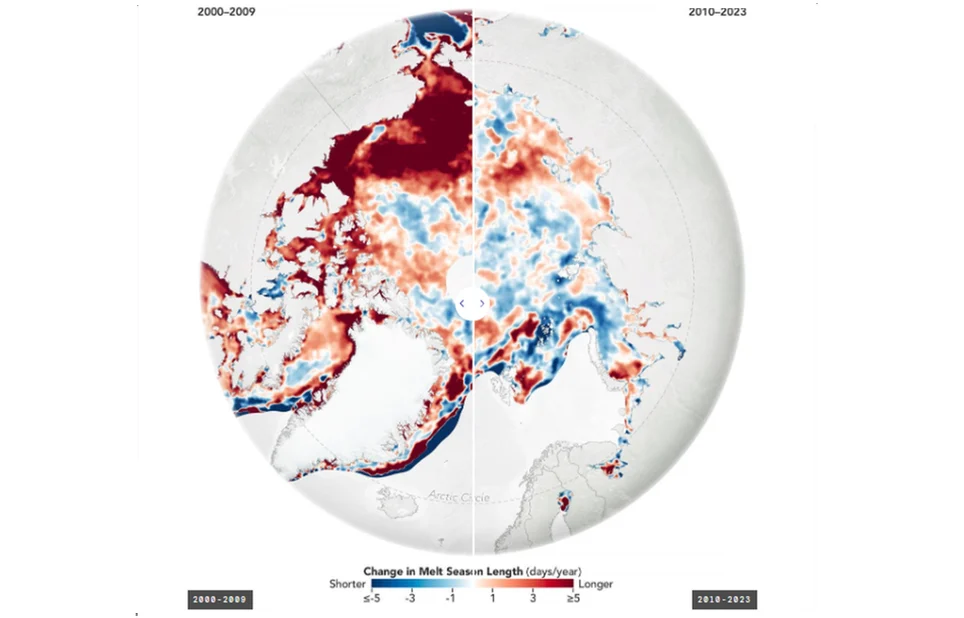
Although the sea-ice melt season has lengthened dramatically for most of the satellite era, the trend unexpectedly stabilised around 2010.
For decades, Arctic sea ice has been melting earlier in spring and freezing later in autumn, extending the melt season and contributing to widespread ice loss. A new NASA-led study has found that, although the Arctic melt season has lengthened dramatically since satellite records began, that trend unexpectedly stabilised around 2010.
 Same as above, but shown as a sequence of decades highlighted in the inset. Images by Michala Garrison based on data from Boisvert, L., et al.
According to the study, the Arctic melt season is now around 40 days longer than it was in 1979. Most of this increase occurred before 2010. Since then, the average length of the melt season has remained relatively stable, despite large year-to-year fluctuations.
Results of the NASA study
The researchers analysed satellite observations made between 1979 and 2023 to determine when sea ice begins to melt each spring and when it freezes again each autumn. They found that this change was mainly due
 English