
Original Record Source.
View the original record authored by ‘Helena Mottram’ at ‘METEORED (Your Weather)’ via recovered Helion Archive database link:
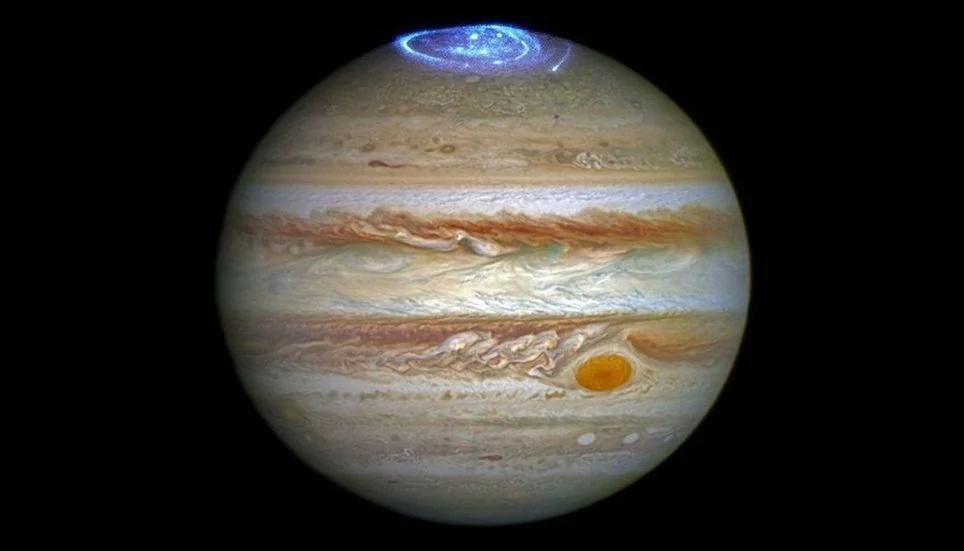
Jupiter and Saturn: 2,000 km/h winds, auroras and extraordinary storms explained by José Miguel Viñas
For many years, the term gas giants was used to describe the four largest planets in the Solar System: Jupiter, Saturn, Uranus and Neptune.
However, following observations of the latter two planets made by the Voyager 2 spacecraft in 1986 and 1989 respectively, they came to be known as ice giants.
This left Jupiter and Saturn in the gas giant category, and we will focus on some of their atmospheric peculiarities here.
Both Jupiter’s and Saturn’s atmospheres are composed mainly of hydrogen and helium, the two lightest and most abundant elements in nature.
Unlike rocky planets such as Earth, Venus and Mars, the two gas giants can be described as almost entirely atmospheric, apart from a small, highly dense inner core containing some solid materials. However, this core is not completely solid but fluid.
Jupiter’s turbulent atmosphere and its long-lasting weather …….
 English