

ORIGIN: https://www.yourweather.co.uk/news/
A new study published in the journal Science reveals how glacial climate and severe cold snaps may have shaped early human evolution using deep-sea sediment cores from Portugal.
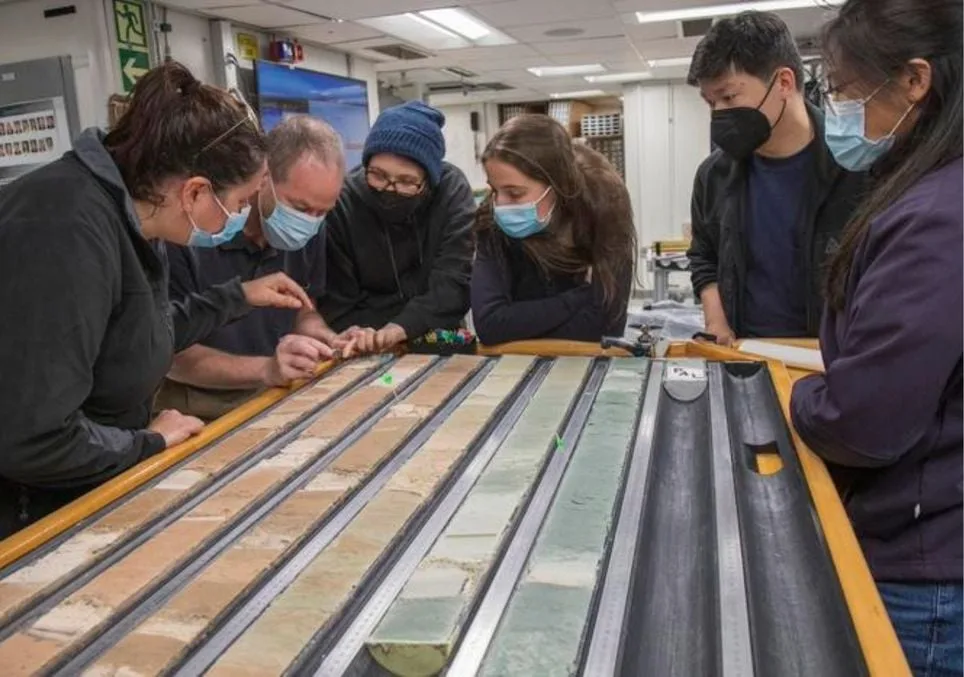 Scientists examining sediment cores. Credit: Carlos Alvarez Zarikian.
 An international team of scientists led by the University of Cambridge has discovered a ‘tipping point’ around 2.7 million years ago, when global climate conditions shifted from warm and stable to cold and chaotic as continental ice sheets expanded in the northern hemisphere.
Following this transition, Earth’s climate would have begun to switch between warm interglacial periods and ice ages due to cyclic changes in the planet’s orbit. However, glacial periods after the tipping point became more variable, with large temperature changes over short periods.
Global ‘tipping point’
The team analysed chemicals in deep-sea cores from Portugal during an expedition by the International Ocean Discovery Program (IODP, where they studied the chemical makeup of the sediments, such as calcium, zirconium, strontium and titanium ratios, to understand how fast the climate was changing.
“Things were relatively quiet until 2.7 million years
![[aggregator] downloaded image for imported item #4736](https://echoesofthelastmind.com/wp-content/uploads/2026/03/global-climate-unbalanced-and-in-state-of-emergency-wmo-say-1774363460082.webp "Global climate unbalanced and in state of emergency, WMO say")
![[aggregator] downloaded image for imported item #4739](https://echoesofthelastmind.com/wp-content/uploads/2026/03/how-a-single-extreme-weather-event-could-affect-your-retirement-savings-1774359584081.webp "How a single extreme weather event could affect your retirement savings")
 English